
Highlights
- Tomographic 3D SPECT imaging of ²²⁵Ac-Trastuzumab using the γ-eye™ system
- Multi-window imaging across selected emissions of the ²²⁵Ac decay chain
- In vivo assessment of daughter radionuclide distribution and kinetics
- Representative tumor visualization at 48h post injection
Introduction
Actinium-225 is a highly promising radionuclide for targeted alpha therapy, but its preclinical imaging remains challenging due to low administered activities and a complex decay chain.
This application demonstrates tomographic 3D SPECT imaging of ²²⁵Ac-Trastuzumab using the BIOEMTECH γ-eye™ system. By acquiring selected energy windows of the ²²⁵Ac decay chain, γ-eye™ supports spatial assessment of both radiopharmaceutical uptake and daughter radionuclide behavior in vivo.
Study design
A SKOV3 tumor-bearing mouse received 172 kBq of ²²⁵Ac-Trastuzumab. Tomographic 3D SPECT imaging was performed at 24h, 48h and 72h post injection, with 30-minute acquisitions.
Images were evaluated across selected energy windows, including 78 keV, 218 keV and 440 keV.
Results
The γ-eye™ system successfully acquired tomographic 3D SPECT images of ²²⁵Ac-Trastuzumab across all evaluated time points.
Figure 1: Representative tomographic 3D SPECT images of ²²⁵Ac-Trastuzumab acquired 48h post injection across selected energy windows of the decay chain. Scan duration: 30 min. Total injected activity: 172 kBq
A scale-matched comparison across 24h, 48h and 72h p.i. demonstrates the ability to follow tracer distribution over time.
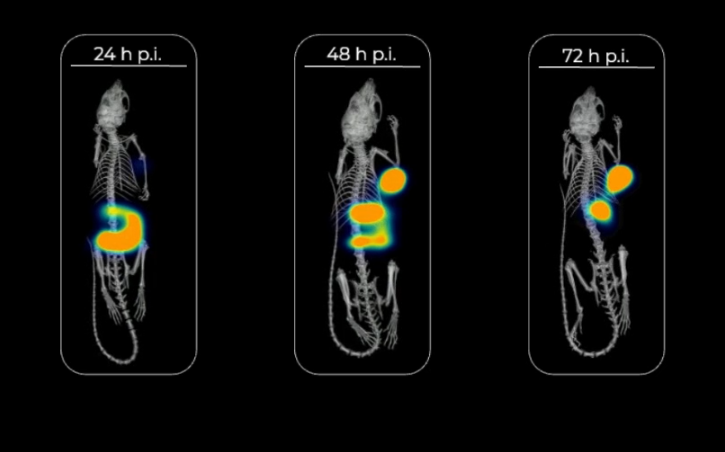
Figure 2: Scale-matched tomographic 3D SPECT images of ²²⁵Ac-Trastuzumab acquired at 24h, 48h and 72h post injection, demonstrating longitudinal assessment of tracer distribution. Scan duration: 30 min per time point. Total injected activity: 172 kBq.
Conclusion
By combining tomographic 3D SPECT imaging with multi-window acquisition across the ²²⁵Ac decay chain, γ-eye™ enables deeper spatial and kinetic assessment of alpha-emitting radiopharmaceuticals.
This capability can support targeted alpha therapy studies where the in vivo behavior of daughter radionuclides is a key scientific question.