
Introduction
Breast cancer is one of the leading causes of death in women across the globe. Although significant advances in research, diagnosis and treatment of the disease have been made in the last decades, it still remains a major health concern. In 2022 approximately 2.3 million women diagnosed with breast cancer globally and 670,000 of them died1. Although age is a predisposing factor, young women are not “immune” to the disease. Women under the age of 40 account for the 5-7% of all breast cancers making it the highest diagnosed cancer for this age group2. The modest improvements in treating the disease by established therapeutic methods have led both the scientific community and pharmaceutical industry in a quest of new approaches. Animal models are an invaluable tool for testing the efficacy and safety of these novel approaches.
Short description of the cell line
Mice are commonly used as induced models, in which an allograft or xenograft is transplanted either ectopically or orthotopically. In breast cancer research, an advantageous model is the transplantation of 4T1 cells in BALB/c mice. The 4T1 cell line is one of the four sublines derived from a spontaneous mammary tumor observed in a BALB/cfC3H mouse and is highly tumorigenic in normal, syngeneic hosts, yielding tumors of generally similar histology, although distinct from the original neoplasm3. Furthermore, it is invasive and, unlike most tumor models, can spontaneously metastasize from the primary tumor in the mammary gland to multiple distant sites including lymph nodes, blood, liver, lung, brain, and bone and is 6-thioguanine resistant4. Significant advantages of the 4T1 cell line are summarized below:
- they are relatively easily manipulated in vitro and in vivo,
- they can be transplanted orthotopically (more closely mimicking the human condition),
- they can invade and metastasize (allowing for modeling a comparable condition to humans after surgical excision of the primary tumor),
- they are resistant to 6-thioguanine which permits a more precise quantification of metastatic cells, even at sub-microscopic levels even at distant organs).
Growth of Tumor
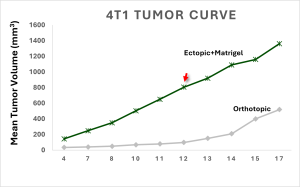
In BIOEMTECH’s laboratories, experience has been acquired on two models of 4T1 cell line syngeneic mouse model, through ectopic and orthotopic transplantation. After induction and maintenance of anesthesia with isoflurane, BALB/c female mice (7 to 12 weeks old) are inoculated ectopically in the subcutaneous tissue (right flank) with 4T1 cells (1 X 10⁶). The cells were mixed with Corning® Matrigel® Basement Membrane Matrix cells. In the second model the 4T1 cells (1 X 10⁴) are inoculated into the 4th right mammary gland of the same type of mice orthotopically. The size of the tumor is evaluated with an electronic caliper. The curve of the tumor’s volume is represented in the figure. For the orthotopic inoculation ulceration was observed on the 13th day, while for the ectopic and ectopic plus Matrigel on the 10th and 12th day respectively (as indicated by the red arrows).
Available Literature Data
Studying cancer development and metastasis was commonly performed on immunosuppressed animals using xenografts. This approach is no longer preferable due to advancements in immunotherapies and the need to understand the more complex mechanisms impacting their efficacies. A more advisable model for the appropriate approximation would be the inoculation of tumor cells into a syngeneic immunocompetent animal such as the 4T1 mouse model for breast cancer studies5.
Luciferase expression through transduction with lentiviral vector of 4T1 cells, encoding firefly luciferase gene has been used as a means for better in vivo bioluminescence imaging of mouse model of breast cancer, but at the same time elicits immune responses from the host animals revealing a mechanism of resistance which may be of interest.
Similarly, although 4T1 mouse model is not appropriate for the study of hormone positive, or Human Epidermal growth factor Receptor (HER) 2 positive breast cancers, constructs may be transfected to 4T1 cells in order to express HER2 and evaluate therapies6,7.
Although 4T1 cells are a highly aggressive and triple-negative murine breast cancer cell line, radioligand therapy (RLT) research focuses on targeting specific tumor markers or tumor microenvironment components to improve therapeutic efficacy while minimizing off-target toxicity. For example, RLT approaches could target markers in the tumor stroma, such as fibroblast activation protein (FAP) in 4T1 mouse models, with high potential to be translated into clinics 8,9.
Furthermore, monoclonal antibodies, or nano-delivered drugs targeting specific features of the pathophysiology of the tumor, can be investigated on the 4T1 mouse model and provide the necessary clues for different pharmacological pathways, which may deliver more efficient therapies and therapeutic approaches against breast cancer10,11.
References
- Breast Cancer Statistics and Resources. www.bcrf.org/breast-cancer-statistics-and-resources/.
- Reyna, C. & Lee, M. C. J Multidiscip Healthc 7, 419–29 (2014).
- Dexter, D. L. et al. Cancer Res 38, 3174–81 (1978).
- Lelekakis, M. et al. Clin Exp Metastasis 17, 163–170 (1999).
- Grzelak, C. A. & Ghajar, C. M. Immunohorizons 7, 64–70 (2023).
- Bakhtiarvand, V. K. et al. J Cancer Res Ther 20, 984–992 (2024).
- Li, P. et al. Front Oncol 10, 1143 (2020).
- Lindeman, S. D. et al. Journal of Nuclear Medicine 64, 759–766 (2023).
- Lindeman, S. D. et al. J Med Chem 67, 11827–11840 (2024).
- Stagg, J. et al. Proc Natl Acad Sci U S A 107, 1547–52 (2010).
- Zhao, Y. et al. Drug Deliv 25, 341–352 (2018).
Please note that animal care and use was conducted at an authorized user establishment in compliance to European legislation on the protection of animals used for scientific purposes (Directive 2010/63/EU).
Author:
Dr. Pavlos Lelovas
Veterinarian, Study Director